Hackers Now Send AI to Break In. Is Your Front Door Locked?
For years, the picture of a hacker was one person hunched over a keyboard, picking one target at a time. That picture is out of date. On November 25, Switzerland’s National Cyber Security Centre (NCSC) confirmed its first cyberattacks on local organizations carried out with AI “agents” — software that plans and runs a break-in largely on its own. In every one of those attacks the agency knew about, the attackers got in.
The same week, Italy’s national cyber team issued a similar warning, describing several AI agents working side by side to break into a large number of systems within a few hours. And earlier this month, the FBI warned that one of these tools has helped some attackers go from first contact to full control of a network in under three hours.
That sounds like science fiction. The fix, thankfully, is not. Let me walk you through what changed, what didn’t, and what I’d do this week if I were in your chair.
What an “AI hacking agent” actually is
Think of an AI agent as a worker who never sleeps and works from a to-do list. You give it a goal — “get into this company” — and it handles the steps itself: find what the company has on the internet, test logins, try known weaknesses, and switch tactics when one door is locked.
Here’s the analogy I use with clients. A burglar used to walk one street a night, checking a few doors. Now he has a fleet of robots that rattle every doorknob in the city at the same time, all night long, and report back on the ones that open.
These tools have names like ARTEX and CyberStrikeAI. Many started out as legitimate testing software for security professionals, and copies now circulate freely online. The Swiss NCSC says the number of these agents openly available to criminals has nearly doubled since October, and the FBI says they take only minimal technical skill to use.
The good news: they still use the same old doors
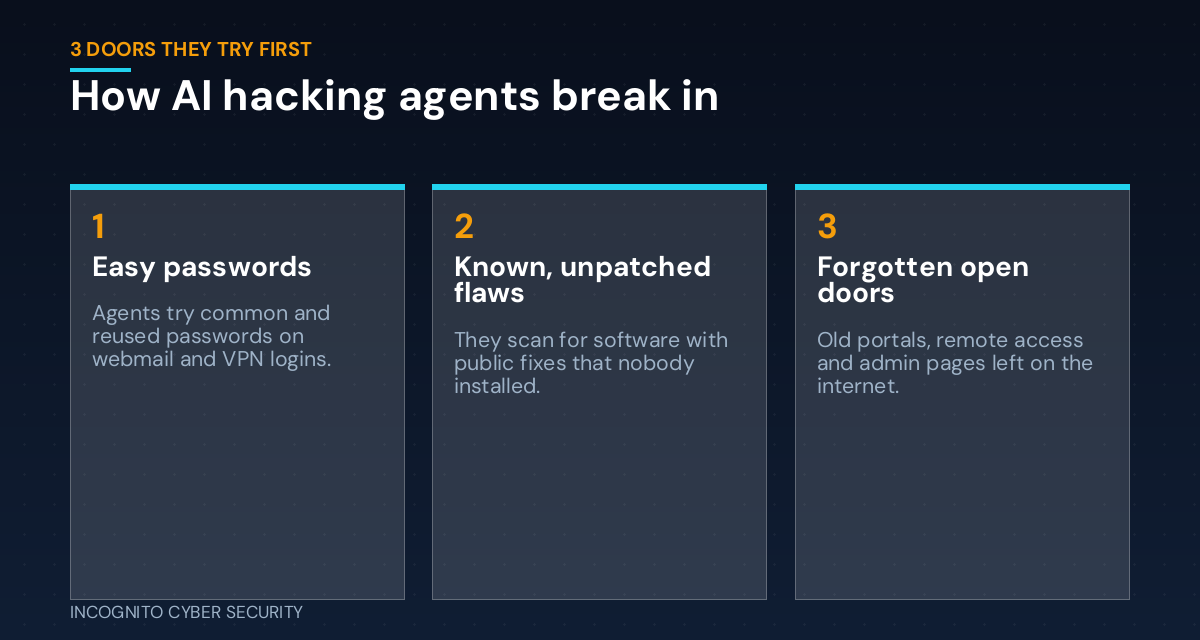
Here’s what I want every owner to take away. The AI is new. The way in is not. According to the Swiss NCSC, these agents go after three things:
1. Easy or reused passwords
Default passwords, simple ones like “Summer2026!”, and passwords reused from another site that was breached. A robot can try thousands of them without getting bored.
2. Known flaws nobody patched
When a software maker releases a security fix, it also tells the world what was broken. Agents scan for systems that never installed the fix — often within hours.
3. Systems left facing the internet
Webmail, remote desktop, VPN logins, firewall admin pages, an old customer portal nobody remembers setting up. The FBI specifically called out overlooked systems like partner portals and legacy services.
None of that is magic. It’s the same list I’ve been writing about on our blog all year. What changed is speed and scale.
Why “we’re too small to be a target” no longer holds up
A human attacker has to choose where to spend time, so small businesses sometimes slipped under the radar. A robot doesn’t choose. It scans everything, and to it, your business’s email login looks exactly like a bank’s.
Speed matters too. The NCSC warns that defenders now have far less time to notice an attack, and it recommends installing critical updates on internet-facing systems within 24 hours of release. For most small businesses I visit, the honest answer is “weeks” or “whenever someone remembers.” That gap is exactly what these tools are built to find.
What you can do this week
- List everything that faces the internet. Email, remote access, VPN, your firewall’s admin page, your website login, any vendor or customer portals. Ask your IT provider for this list in writing, and turn off anything you don’t use.
- Turn on multi-factor authentication for everything on that list — no exceptions. The Swiss agency was blunt about webmail and VPN in particular. Where you can, use an authenticator app or passkey instead of text codes. (Here’s why stolen logins move so fast.)
- Shorten your patch clock. Critical updates for internet-facing gear — firewalls, routers, remote access tools — should go on within a day or two, not a month. See how to keep your router and firewall patched.
- Retire easy and reused passwords. A password manager gives every account a unique, strong password. Start with email and admin accounts, and pair it with a short security awareness session so your team knows why it matters.
- Make sure someone is watching after hours. These attacks don’t keep office hours. Endpoint protection with real alerting catches strange activity at 2 a.m., and spam and virus filtering stops many of the phishing emails that hand over passwords in the first place.
- Test your backups. If something does get through, an offline, tested backup is the difference between a bad day and a closed business.
The bottom line
AI didn’t invent new ways to break into a small business. It made the old ways faster, cheaper, and available to almost anyone. The businesses that get hurt won’t be the ones that missed some exotic new trick — they’ll be the ones that left an easy door unlocked. Lock the basics, shorten your patch window, and have someone watching. That beats the robots.
Not sure what’s facing the internet?
We’ll map what your business exposes online, check your logins and patch status, and give you a plain-English list of what to lock down first.
Book a complimentary visit → See our small business security solutions
Send us a message
— Nemuel Cruz, Incognito Cyber Security