Holiday Scams Are Aimed at Your Office. Is Your Team Ready?
Every December, the news warns shoppers about fake deals and phony delivery texts. Here’s what those stories usually miss: the same scams land in your office inbox, on your front desk phone, and in your employees’ text messages. And at work, the stakes are a lot higher than one lost package.
This week, TechRadar reported on a new Gallagher study of UK businesses: about one in four were hit by scams that tricked staff into sharing sensitive information or sending money, and three out of five took more than 24 hours just to notice a fraud had happened. At the same time, reporters like Fox News’ CyberGuy are flagging the usual holiday suspects again: fake delivery notices, gift card requests, and fake order alerts. Put those together and the picture is clear. The busiest, most distracted weeks of the year are exactly when scammers go after small businesses.
Think of it like a mall parking lot in December. The car thieves don’t get any smarter during the holidays. There are just more cars, more bags in the back seat, and more people in a hurry. Right now, your office is that parking lot.
Why the holidays are prime time for scammers
Three things change in a small business between Thanksgiving and New Year’s, and scammers count on all of them.
More packages, more “delivery problems”
Your team is ordering supplies, client gifts, and year-end equipment. When a text says a package couldn’t be delivered, it doesn’t sound strange. It sounds like Tuesday.
People are rushed and short-staffed
Vacations and year-end deadlines mean fewer people to double-check things and more pressure to “just get it done.”
Generosity is in the air
Gift cards for staff, client thank-yous, donations. A request to buy gift cards that would look odd in March looks perfectly normal in December.
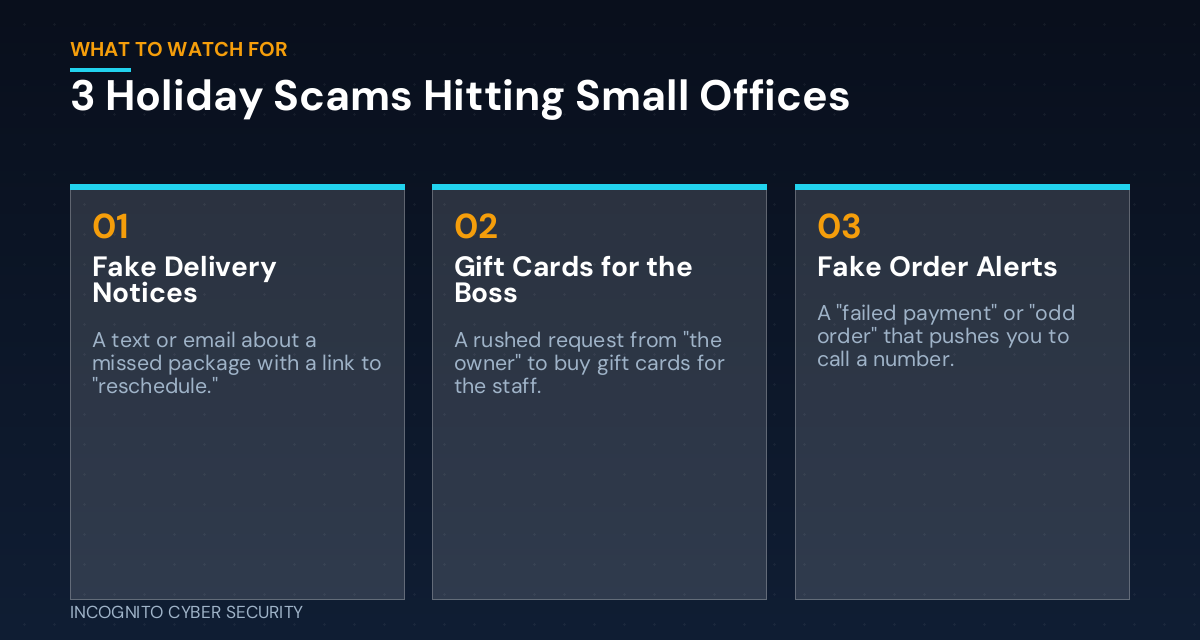
The three scams I see hitting small offices
1. Fake delivery notices
A text or email that looks like it came from UPS, FedEx, or USPS says your package is on hold. Click to reschedule, confirm your address, or pay a small “redelivery fee.” The link goes to a fake page built to collect card numbers or logins. The Postal Service has confirmed it does not charge redelivery fees. If one of your employees types in a company card or their Microsoft 365 password, the scammer now has a foothold in your business.
2. Gift cards for “the boss”
This is the classic. An employee gets a text or email that appears to come from the owner: “I’m stuck in a meeting. Can you pick up ten $100 gift cards for client thank-yous and send me the codes? I’ll pay you back.” It plays on your staff wanting to help and not wanting to bother you. Once the codes are sent, the money is gone. Gift cards are nearly impossible to recover.
3. Fake order or payment alerts
“Your order for $899 has been placed. If you didn’t make this purchase, call us.” Or: “Your payment failed. Update your billing.” The goal is to get someone to call a fake support line, where a friendly “agent” asks for card details, a verification code, or permission to remote into the computer to “fix” it. That last one is the worst outcome, because it hands a stranger the keys to a company PC. I covered this phone-based trick in more detail in One Phone Call Can Open the Door to Your Business.
What makes these work (and how to break them)
Every one of these scams depends on two ingredients: urgency, and a link or phone number the scammer controls. Take away either one and the scam falls apart.
The fix isn’t a fancy tool. It’s a habit: go around the message. If a text says a package is stuck, open the carrier’s app or type the website in yourself. If “the owner” asks for gift cards, call the owner on the number you already have. If an email says an order went through, log into the account directly, never through the link.
That’s also why security awareness training matters more than most owners think. Your team is the filter that catches what technology misses.
What you can do this week
- Send your staff a two-minute holiday heads-up. Name the three scams above, and tell them it’s okay to slow down before clicking or paying.
- Set a “no gift cards by text or email” rule. Say it out loud: “I will never ask you to buy gift cards by text or email. If you get that request, it’s not me.”
- Use a call-back rule for anything involving money. Any request to pay, buy, or change payment details gets verified with a phone call to a number you already know, not the one in the message.
- Check your email filtering. Good spam and virus filtering stops many fake delivery and order emails before anyone ever sees them.
- Make sure every computer has endpoint protection. If someone does click, endpoint protection can block the malicious page or download.
- Tell people exactly who to call. Post a simple “if you clicked something, call ___ right away” note. Most businesses take more than a day to notice fraud. The faster you hear about it, the less it costs.
Bottom line
Scammers don’t take holidays. They plan around yours. A short reminder to your team, a simple call-back rule, and the right filters will stop most of these scams before they cost you a dime. If you want a broader starting point, take a look at our small business cybersecurity solutions, make sure your data backups are solid in case the worst happens, and browse more plain-English tips on our blog.
Want a holiday security check-up?
We will sit down with you for a free visit, review your email filtering and endpoint protection, and walk through how your team handles payment and gift card requests. No cost, no pressure.
Send us a message
Did someone on your team get a suspicious text, email, or gift card request? Send us a note and we’ll help you sort out what’s real.
— Nemuel Cruz, Incognito Cyber Security